+86 15093323284 hams@ailunce.com




What Is Cross Band Repeat | Handheld Radio Guide
1. Introduction: Cross Band Repeat Is Not Just for Mobile Rigs
When people hear "cross band repeat," many immediately think of mobile rigs — high power, good heat dissipation, mounted in vehicles. This is correct but incomplete.
In fact, cross band repeat is also available on certain high-performance handheld radios. This means you don't need a vehicle or a bulky mobile rig. A device that fits in the palm of your hand can serve as a bridge between UHF and VHF.
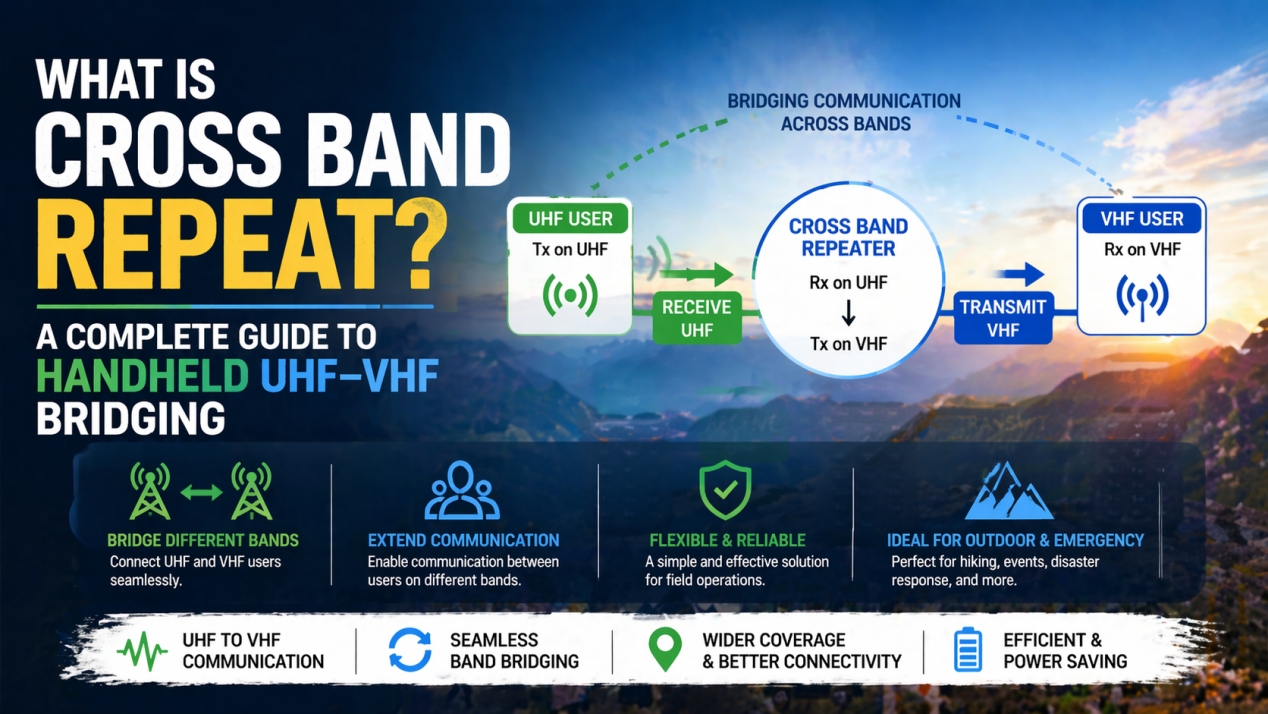
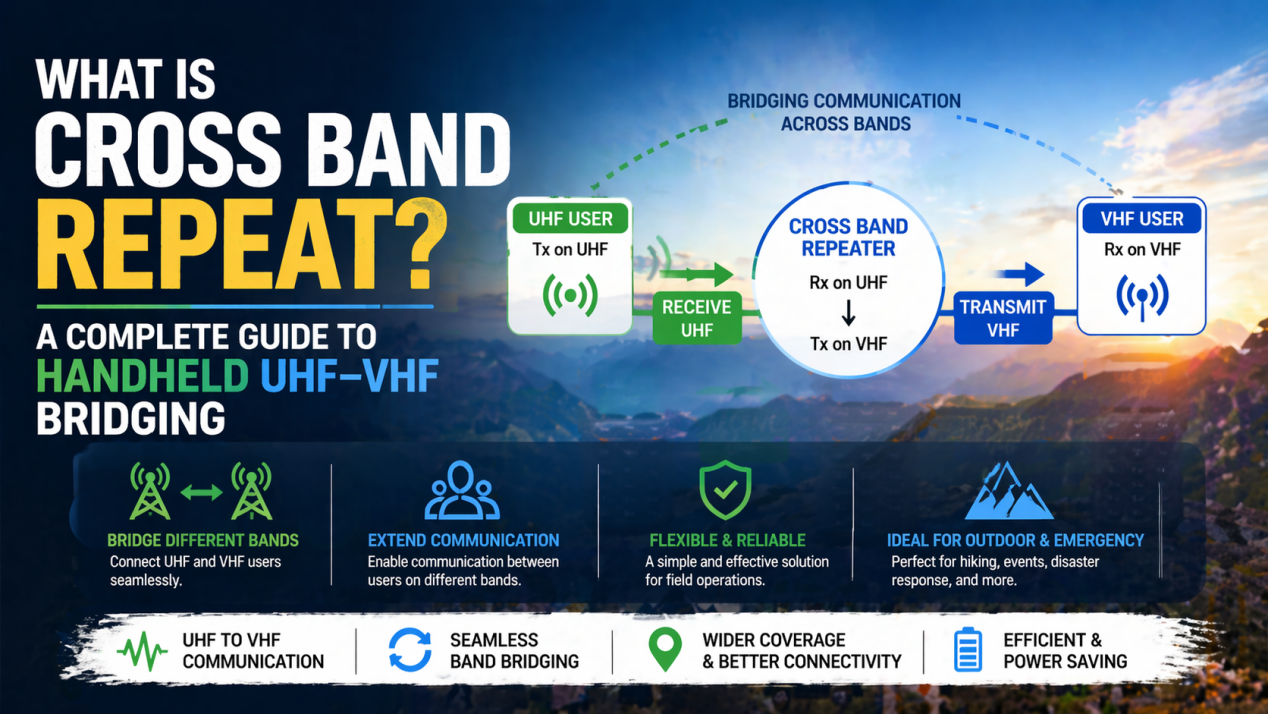
Cross band repeat is a feature that allows a radio to receive a signal on one frequency band and simultaneously retransmit it on another band.
This article will systematically explain what cross band repeat is, with a focus on how handheld radios can perform cross band repeat, compare handheld solutions with mobile rigs, and help readers choose the right equipment for their needs. Finally, we will introduce the RETEVIS RA89R, a radio designed specifically for handheld cross band repeat.
2. What Is Cross Band Repeat?
2.1 Definition
Cross band repeat refers to the ability of a dual band radio to automatically receive a signal on one band (e.g., UHF) and retransmit it on another band (e.g., VHF).
In one sentence:
Cross band repeat is a bridge between UHF and VHF.
If half of your team uses UHF radios and the other half uses VHF radios, cross band repeat allows them to communicate without anyone having to change equipment.
2.2 The Core Value of Cross Band Repeat
Cross band repeat solves a very practical problem: devices on different bands cannot talk to each other without assistance.
In practical terms, this means:
One radio bridges UHF and VHF — different radio systems connect seamlessly
Existing equipment can be fully utilized without replacement
Full coverage and unified command become achievable
Automatic signal reception, amplification, and forwarding between UHF and VHF
No coverage dead zones, smooth cross-region communication, rapid emergency response, and efficient on-site coordination
Simply put: it automatically forwards signals between UHF and VHF, seamlessly connecting two communication networks that otherwise could not talk to each other.
3. Handheld Cross Band Repeat vs. Mobile Rig Cross Band Repeat
To help readers better understand the positioning of handheld cross band repeat, here is a systematic comparison.
3.1 Core Differences Comparison Table
|
Comparison Dimension |
Handheld Cross Band Repeat |
Mobile Rig Cross Band Repeat |
|
Form Factor |
Handheld radio, portable |
Fixed mobile radio in vehicle |
|
Portability |
High — fits in backpack or on belt |
Low — installed in vehicle |
|
Transmit Power |
Typically 5-10W |
Typically 25-50W |
|
Heat Dissipation |
Limited — passive cooling |
Better — often has cooling fan |
|
Power Source |
Internal battery (hours) |
Vehicle battery (long duration) |
|
Antenna |
Built-in short antenna or aftermarket |
External roof-mounted, higher gain |
|
Use Cases |
Personnel movement, field operations, temporary repeater |
Vehicle as fixed relay point |
|
Deployment Speed |
Instant — no installation required |
Requires antenna mounting and wiring |
|
Cost |
Relatively lower |
Relatively higher (radio + antenna + installation) |
3.2 Advantages and Limitations of Each
Handheld Cross Band Repeat Advantages:
High flexibility — can be used while moving, outside vehicles, inside buildings
Rapid deployment — no installation, ready to use out of the box
Lower cost — one device can perform cross band repeat
Suitable for temporary scenarios: field operations, emergency communication, event support
Handheld Cross Band Repeat Limitations:
Limited transmit power — shorter range than mobile rigs
Limited heat dissipation — not suitable for long-duration high-load operation
Battery life constraints — requires spare batteries or charging
Mobile Rig Cross Band Repeat Advantages:
Higher power — longer range
Better heat dissipation — can operate continuously for extended periods
Higher antenna placement — better signal quality
Mobile Rig Cross Band Repeat Limitations:
User cannot leave the vehicle
Complex installation — requires professional wiring
Higher cost
3.3 Selection Recommendations
|
Use Scenario |
Recommended Solution |
Reason |
|
Hiking, camping |
Handheld cross band repeat |
Lightweight, portable |
|
Emergency communication |
Handheld cross band repeat |
Rapid deployment, flexible |
|
Vehicle convoy |
Mobile rig cross band repeat |
High power, long operation time |
|
Fixed relay point (e.g., hilltop) |
Mobile rig + battery |
Large coverage area |
|
Temporary cross-team coordination |
Handheld cross band repeat |
Low cost, instant use |
Key conclusion: Handheld cross band repeat is better suited for personnel mobility, rapid deployment, and temporary networking. Mobile rigs are better for fixed locations, long-duration operation, and wide coverage. The two are complementary, not substitutes.
4. How Cross Band Repeat Works
4.1 Basic Workflow
Whether on handheld devices or mobile rigs, the working principle of cross band repeat is the same:
Receive: The device receives a signal on Band A (e.g., UHF 430 MHz)
Convert: The device internally converts the signal to another band
Retransmit: The device transmits the signal on Band B (e.g., VHF 146 MHz)
This process is automatic — the user does not need to manually switch bands.
4.2 Typical Application Scenario Diagram
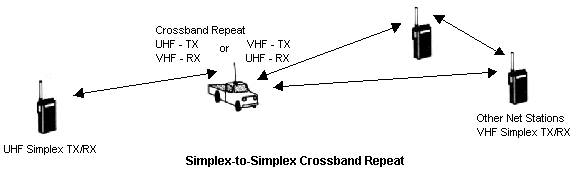
Through this method, UHF devices and VHF devices that cannot communicate directly become connected via a handheld cross band repeat device.
5. Two Operating Modes of Handheld Cross Band Repeat
Based on practical experience, handheld cross band repeat can operate in different modes. Understanding these modes helps users choose the right setup for their needs.
5.1 Mode 1: Two-Way Full Repeat
In this mode, the handheld device forwards signals from both ends:
Forwards UHF-received signals to VHF
Forwards VHF-received signals to UHF
Use case: Scenarios with few devices on both ends and low communication frequency.
Note: If there is heavy traffic on both ends, the device's duty cycle increases significantly, which may increase heat generation and battery consumption.
5.2 Mode 2: One-Way Forwarding
In this mode, the handheld device forwards signals in only one direction — from one band to the other — not both ways.
Use case: Scenarios where one band needs to "listen" to the other band, but two-way conversation is not required.
Advantages: Lower device load, longer battery life, less heat generation.
5.3 Mode Comparison
|
Comparison Item |
Two-Way Full Repeat |
One-Way Forwarding |
|
Communication direction |
Two-way |
One-way |
|
Device load |
Higher |
Lower |
|
Battery consumption |
Faster |
Slower |
|
Heat generation |
Higher |
Lower |
|
Use case |
Two-way conversation needed |
One-way information relay |
6. Best Practices for Cross Band Repeat (Based on Industry Guidelines)
According to technical documentation from organizations such as the Western Washington Amateur Relay Association (WWARA), the following best practices are recommended when using cross band repeat.
6.1 Technical Preparation
|
# |
Best Practice |
Explanation |
|
1 |
Use tone/DCS encode and decode on both sides |
Prevents accidental triggering by unrelated signals or environmental noise |
|
2 |
Test each link individually before enabling |
Ensures both sides work reliably on their own |
|
3 |
Use minimum necessary power |
Cross band repeat increases device load — lower power means less heat and less battery drain |
|
4 |
Be aware of additional delay |
Tone encode/decode adds approximately 0.25-0.5 seconds of delay — wait briefly before speaking |
6.2 Operational Standards
|
# |
Best Practice |
Explanation |
|
5 |
Notify relevant parties before use |
Basic courtesy if connecting to others' repeaters or networks |
|
6 |
Always monitor while active |
Enables shutting down the link if issues occur |
|
7 |
Follow identification requirements |
Applicable regulations require identification of both link sides |
|
8 |
Do not wait until you need it to test it |
Operation methods and menu logic vary significantly between brands |
6.3 Common Misconceptions
|
Misconception |
Correct Approach |
|
Any dual band radio supports cross band repeat |
Only certain models support it — verify before purchase |
|
Cross band repeat can be left on permanently |
Enable only when needed — long-duration use requires attention to heat |
|
Higher power is always better |
Minimum necessary power is safer for cross band repeat scenarios |
7. RETEVIS RA89R: A Solution Designed for Handheld Cross Band Repeat
After understanding the technical principles and usage requirements of cross band repeat, a natural question arises: what handheld device can reliably perform this task?
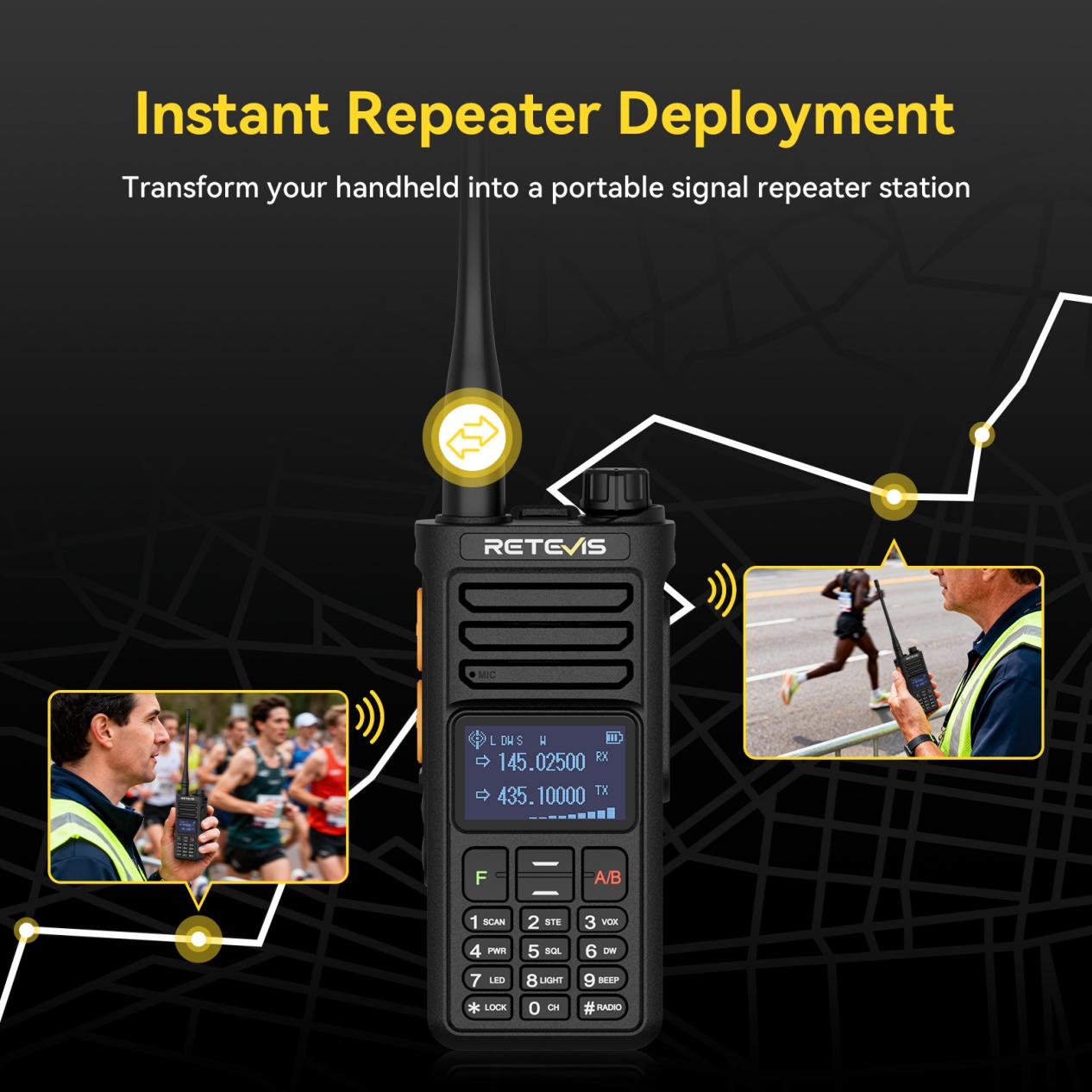
The RETEVIS RA89R is a dual band handheld radio that supports cross band repeat functionality.
7.1 Product Positioning
The RA89R is designed around a simple principle: a handheld radio can also serve as a communication bridge between UHF and VHF. It does not require the high power or complex installation of a mobile rig — it is a portable, rapidly deployable cross band repeat solution.
7.2 Core Capabilities
Cross Band Repeat Function
The RA89R supports standard UHF↔VHF cross band forwarding, completing the full process of signal reception, conversion, and transmission between the two bands. Whether connecting devices on different bands or serving as a temporary relay point, the RA89R is capable of handling the task.
Portable Deployment
Unlike mobile rigs that require antenna mounting and power wiring, the RA89R is ready to use out of the box. In scenarios requiring rapid response — emergency communication, field operations — this "instant-on" capability is especially valuable.
Broad Compatibility
The RA89R works with existing UHF or VHF equipment without requiring any replacement or upgrade of current devices. This means users can achieve cross band communication capabilities at a relatively low cost.
7.3 Product Core Value Summary
The RETEVIS RA89R allows users to bridge UHF and VHF with a single handheld device, seamlessly connecting different radio systems. It fully integrates existing equipment and enables full coverage with unified command.
For users who need to connect different teams and handle complex communication scenarios, the RETEVIS RA89R offers a solution that combines portability, flexibility, and cost-effectiveness.
8. User Scenario Examples
Scenario 1: Emergency Communication Site
During a natural disaster response, fire, medical, and police teams arrive on site, each using different frequency bands. Under normal conditions, they cannot communicate directly.
Solution: Deploy one RA89R on site as a cross band repeater, set to forward signals between UHF and VHF. All three teams can achieve unified communication without replacing any equipment.
Scenario 2: Outdoor Team Activity
On a hiking trip, some team members use UHF radios while others use VHF radios. The team leader carries an RA89R and places it at a high point (hilltop, tree branch) as a temporary repeater, allowing the entire team to stay in contact regardless of which band they use.
Scenario 3: Cross-Department Coordination
At a large construction site or industrial campus, the security department uses UHF equipment while the engineering department uses VHF equipment. The central dispatch room uses an RA89R as a cross band repeater, enabling unified dispatch and rapid response across both departments.
9. Summary
Cross band repeat is a highly practical feature that solves the core problem of incompatible communication between devices on different bands.
Key takeaways:
What is cross band repeat? Automatic receive and retransmit between UHF and VHF
Handheld vs. mobile rig: Handhelds are more flexible and portable; mobile rigs have higher power — complementary, not substitutes
Best practices: Use tones, minimum power, test in advance
Equipment choice: The RA89R is a portable solution for handheld cross band repeat
Whether for emergency communication, field operations, or multi-team coordination, mastering the correct use of cross band repeat can significantly enhance communication capability. And choosing the right handheld device — such as the RETEVIS RA89R — ensures this feature works whenever and wherever it is needed.